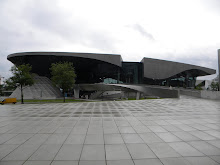
My favorite type of landscape is considered both natural and manufactured. Built by an architect, the golf course is all about framing views and creating circulation so you start and finish near the clubhouse. From the tee box, a certain threshold is created by the surrounding trees, bunker traps, etc., leading up to the green (your destination). I have been to some courses where they have used shorter, wider trees and shrubs to help frame the low line horizon of the surrounding area, same as Frank Lloyd Wright designed low, long houses to do the same. However, these landscapes take a great deal of maintenance to keep up, which could end up to be beneficial because, if the money is there, these landscapes could stand the test of time and outlast other landscapes that are being ruined by harsh weather, neglect, and pollution. Being manufactured, made by the hand, it is being treated and taken care of daily. The "Old Course" at ST. Andrews is said to have been around since 1506, played by King James IV. Some say that it is in the best condition now than it has ever been. With that being said, why can't we use the same techniques to preserve all other natural landscapes regardless of whether they are a national park or not?
Monday, February 22, 2010
Landscaping
When most people think of a landscape, they usually think of some sort of natural setting be it an open field, valley, mountain range, etc. The landscape is said to "comprise the visible features of an area of land, including physical elements such as landforms, living elements of flora and fauna, abstract elements like lighting and weather conditions, and human elements like human activity and the built environment" (Wikipedia). Landscapes don't always have to be made strictly by nature however. There are manufactured landscapes as well. Even ruins left behind can be considered as a landscape.


Code of Ethics
The last two weeks, we as a class have been developing a 'code of ethics' for the LA Tech School of Architecture. We were each asked to come up with some suggestions of what should be in it or how to present it, etc. I feel that most people these days are very visual, I know I am. So I thought a diagram would be a good representation for our 'code of ethics'. I created it in an architectural program called Rhinoceros 4.0 using a tool called Grasshopper. Basically, the words in the middle are verbs or character traits that best describe how young professionals should be or act in a sense, and the outer words describe who we have that responsibility or obligation to.
Thursday, February 4, 2010
Obligations of Studio Culture (Code of Ethics)
As architecture students at Louisiana Tech University, I feel we have obligations to ourselves first and foremost, our professors and fellow students, the university, and the community around us. We have an obligation to ourselves to strive to go above and beyond what is expected of us, to further our education, and to produce good work. Without these expectations, what good are we to the firms we apply to when we graduate. The more we learn and know, the more we bring to the table. We also have an obligation to our teachers to produce good, coherent, and new work every time we talk to them to not waste their time. We have an obligation to our fellow students, to respect them, their work, and their work space. Don't steal things from your fellow students such as their tools and their work. We should show interest in our friends work. I've had many of my classmates help me out with my projects, giving me advise on things that I may have never seen before to better my projects, and I have returned the favor. That is what studio culture is all about. We also have an obligation to Louisiana Tech University, as they are the ones that supplied us with our facilities and equipment that we use, such as the plot room, laser cutter, router, etc. We should show respect to them by treating the facilities and equipment with the utmost care. We should also strive to participate more in school activities to better the university. Finally, we have an obligation to the community around us. With classes such as CDAC (Community Design Assistance Center) and Habitat For Humanity, we have a voice in the community, and we need to use it to possibly help the community and raise awareness of green architecture to help the environment. These obligations, i think, are very important to consider when writing a code of ethics for the School of Architecture at LA Tech.
Subscribe to:
Posts (Atom)